Bat Ear Correction: Causes, Treatments & Results
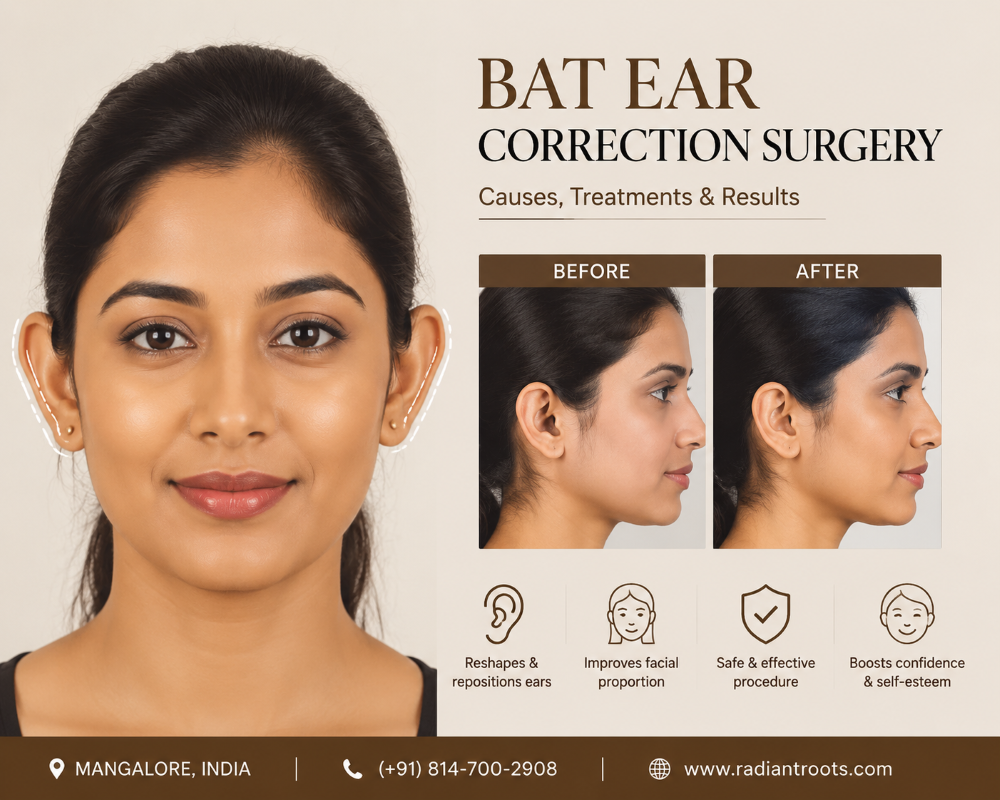
If you've spent years angling for photos, tucking your hair a certain way to cover your ears, consider ear correction surgery in Mangalore. Prominent or "bat" ears are one of the most common ear irregularities people live with, affecting close to 5% of people worldwide. It rarely causes any physical harm, but can quietly impact one’s self-confidence.
Ear correction surgery, medically known as otoplasty, has become one of the most refined procedures in cosmetic surgery today. Techniques have improved enough that incisions are tucked neatly behind the ear, scarring is minimal– nearly invisible, and results are consistently strong. Clinical studies report patient satisfaction rates as high as 90 to 97% globally.
This blog will guide you through the causes of such ear shape, treatment options, and what real recovery looks like, helping you make an informed decision.
Bat Ear Deformity
Overview
A "bat ear" isn't a medical flaw or a sign of anything wrong internally — it's simply a difference in how the ear's cartilage folded during development.
Bat ear deformity, commonly known as prominent ear or protruding ear, is a congenital condition where the ears sit further out from the head than what's typically considered proportionate.
The ear gets its shape from a fold called the antihelix, which normally curves the outer rim of the ear inward, closer to the head. When this fold doesn't form properly, or when the bowl-shaped part of the ear (the concha) grows larger than usual, the ear grows at a wider angle from the head.
It's purely a structural and cosmetic difference. It doesn't affect hearing, balance, or ear function in any way — the concern is entirely about appearance and, often, the confidence that comes with it.
Causes
Bat ears typically develop for one or a combination of these reasons:
Underdeveloped antihelix fold — the cartilage ridge that should fold inward doesn't form as expected during fetal development.
Enlarged conchal bowl — the central cup of the ear grows disproportionately large, pushing the ear outward.
Genetics — prominent ears often run in families, though not always predictably; a parent with the trait doesn't guarantee a child will have it.
Combination deformities — many cases involve both an underdeveloped fold and an enlarged bowl together, which is why treatment is rarely one-size-fits-all.
In most cases, the shape is present from birth and becomes more noticeable as the ears finish growing, usually by around age five or six.
Treatment Options for Bat Ear
Non-surgical
Non-surgical ear molding only works in a very narrow window — the first few weeks of a newborn's life, while cartilage is still soft from residual maternal hormones.
Once that window closes, cartilage firms up permanently, which is why non-surgical molding isn't an option for adults. Some people also try cosmetic ear tape or clips for temporary, short-term reshaping before an event, but these don't create any lasting change once removed.
Surgical (Otoplasty)
For adults, otoplasty is the only method that produces a permanent correction, and surgeons typically choose from three established approaches based on how firm the cartilage is and how it's shaped:
- Suture technique – permanent internal stitches reshape and reposition the cartilage without removing any tissue.
- Cartilage-scoring technique – shallow scores are made in the cartilage to encourage it to bend naturally into the desired shape.
- Cartilage-cutting technique – a small amount of cartilage is trimmed for more significant reshaping, generally used for firmer, adult cartilage.
The incision, in nearly every case, is placed in the natural crease behind the ear, which is why visible scarring is rarely a concern once healing is complete. The right technique depends on age, cartilage thickness, and the specific structural cause.
Getting an Ear Correction Surgery Helps In
● Reshaping and repositioning the ears closer to the head, reducing prominence and creating a more natural, balanced look
● Correcting asymmetry when one ear sits differently from the other
● Improving the proportion between the ears and the rest of the face in photographs and everyday appearance
● Reducing the self-consciousness that often builds up over years, particularly for children who've faced teasing
● Creating results that are permanent in the vast majority of cases, with no ongoing maintenance needed
● Allowing more freedom with hairstyles, including shorter cuts or hair worn up, without needing to hide the ears
Recovery Timeline After Ear Correction Surgery in Mangalore
Immediately after surgery (Day 1–7)
● A padded headband or dressing is worn to protect the new shape and reduce swelling
● Mild to moderate discomfort is normal and manageable with prescribed pain relief
● Most people take about a week off school or work
Early healing (Week 2–4)
● Swelling and bruising steadily reduce
● A lighter headband is often worn at night only, to protect the ears during sleep
● Light daily activities can usually resume, though contact sports and swimming are avoided
Settling phase (Month 1–3)
● The ears continue to soften into their final position as internal healing completes
● Numbness or tightness around the incision site, if present, typically fades during this period
● Most visible swelling is gone by this stage, though subtle refinement continues
Final results (Month 3–6)
● The ear shape is considered fully settled, with results holding steady long-term in most patients
Risks and side effects to be aware of
● Temporary swelling, bruising, or tenderness — expected and short-term
● A small chance of mild asymmetry during healing, which usually resolves on its own
● Rare risk of infection or scarring, minimised significantly with proper aftercare and an experienced surgical team
● Scars are placed in the natural crease behind the ear, making them barely noticeable once healed
Wrapping Up
Having prominent ears isn't physically harmful in any way — but the effect it can have on self-esteem, especially through childhood and adolescence, is very real and shouldn't be dismissed.
With advanced cosmetic treatments like Otoplasty, you can redefine your facial appearance with nearly invisible traces.
As a trusted cosmetic surgery clinic in Mangalore, Radiant Roots has built its reputation on results that look natural, not "done."
So, if you're exploring your options for correcting your ear shape or size, consider a consultation with our top cosmetic surgeon in Mangalore, Dr. Chandra — assess your ear structure individually and walk through a plan suited to you.
Frequently Asked Questions
Does otoplasty affect hearing? No. Otoplasty only reshapes the outer cartilage of the ear. It doesn't involve the ear canal, eardrum, or any internal hearing structures, so hearing is completely unaffected.
What age is right for otoplasty — for kids vs. adults? Most surgeons recommend waiting until a child is around 5 to 6 years old, by which point the ears have reached nearly their full adult size. There's no upper age limit for adults — otoplasty is performed safely at any age once someone is in good general health.
Is there an ideal "ear shape or size" I should aim for? Not really. The goal of otoplasty isn't a fixed template — it's proportion and natural symmetry relative to your own face and head shape. A good surgeon designs the correction around your individual features rather than a one-size-fits-all standard.
Is ear correction surgery reversible or permanent? It's intended to be permanent. The cartilage is reshaped and held in its new position while it heals, and in the vast majority of patients, results remain stable for life.
How long does otoplasty surgery take? Most procedures take between 1 and 2 hours, depending on whether both ears are being corrected and which technique is used.
Is bat ear correction surgery safe? Yes. Otoplasty is considered one of the safer cosmetic procedures, with a low complication rate when performed by an experienced surgeon. Serious complications are uncommon, and most side effects are minor and temporary.
Are the scars visible? Incisions are placed in the natural crease behind the ear, so scars are hidden from the front and typically fade to be nearly undetectable within several months.
How long until I can see the final result of ear correction surgery? Initial shape is visible as soon as the dressings come off, but final, fully settled results usually take about 3 to 6 months as swelling resolves completely.
How much does otoplasty cost in Mangalore? Costs vary based on technique, complexity, and whether one or both ears are treated, but otoplasty in Mangalore generally ranges from around ₹35,000 to ₹90,000. A clinic consultation is the only way to get an accurate quote for your specific case.
Can I wear my hair up or short after ear correction surgery? Yes, and for many people this is one of the most appreciated results. Once healing is complete, there's no need to style hair around the ears to hide them, opening up far more hairstyle options.