Hair Transplant for Men: When Is the Right Time?
There is no single age at which a hair transplant becomes "right." What actually determines the right time is a combination of four things: your age, your pattern of hair loss, the strength of your donor area, and how clearly your expectations match what surgery can realistically deliver.
Almost every man who walks into a hair loss consultation asks some version of the same question: am I doing this too early, or have I already waited too long?
It is a fair question, and an important one. Unlike most cosmetic procedures, a hair transplant is permanent. The grafts placed today have to work with whatever your hair loss looks like ten or twenty years from now — not just today.
At Radiant Roots, the decision to proceed with a hair transplant in Mangalore is based upon careful medical evaluations along with the degree of baldness.
Let's go through each of these properly.
What Is Actually Happening When Hair Starts Thinning?
Most male hair loss is androgenic alopecia — commonly called male pattern baldness. It is driven by dihydrotestosterone (DHT), a hormone that gradually shrinks hair follicles in genetically susceptible areas, usually the hairline, temples, and crown.
This is a progressive condition. It does not stay still. A hairline that has receded slightly at 26 will, in most cases, continue to recede over the following years — the rate and extent depend largely on genetics and family history.
This progressive nature is precisely why timing a hair transplant correctly requires more than just looking at how much hair you have lost so far. It requires anticipating how much more you are likely to lose.
The predictable Hair loss patterns:
- Receding temples
- Thinning at the crown
- Diffuse reduction in density
- Progressive enlargement of bald areas
The severity is commonly assessed using the Norwood Scale. The stability of the hair loss pattern is imperative than the actual stage.
Is There an Ideal Age for Hair Transplant Surgery?
As said earlier, there is no universal “best age” for a hair transplant.
In the Early to Mid-20s
This is the age group where caution matters most. Hair loss in the early 20s tends to be unpredictable — it can still be evolving, and the eventual pattern may not be clear yet.
Operating on a hairline that has not stabilised risks an outcome that looks mismatched in a few years.
This does not mean a transplant is off the table at this age. It means the evaluation needs to be more conservative.
Concerns include:
- Rapidly progressing hair loss
- Unstable hairline changes
- Unrealistic expectations
- Limited understanding of future hair loss
In some cases, medical treatments such as finasteride or minoxidil may be recommended before surgery.
Between 28 and 40 Years
This window offers the best balance — often represents the most suitable candidates.
By this stage:
- Hair loss patterns are generally more predictable.
- The rate of progression becomes clearer.
- Donor areas are easier to assess.
- Long-term planning becomes possible.
If you fall within this age group and are considering a hair transplant in Mangalore, your treatment plans can be tailored with greater accuracy.
Above 40s and Beyond
Age itself is rarely a barrier. What matters more at this stage is donor area strength and overall scalp health. Some men in their 40s and 50s have excellent donor density and are very good candidates. Others may have donor thinning as well, which changes what is realistically achievable.
Men in their forties and fifties can achieve excellent outcomes.
At this stage:
- Hair loss is usually stable.
- Future progression is easier to anticipate.
- Expectations are often more realistic.
The key difference at this age is that expectations are usually evaluated against a longer history of hair loss, which actually makes planning more accurate.
Why the Donor Area Often Matters More Than Age
Hair used in a transplant is taken from the back and sides of the scalp — the occipital and parietal zones — because hair here is genetically resistant to DHT. This donor hair retains that resistance even after being moved to thinning areas, which is why transplanted hair does not fall out the way native hair in affected zones eventually might.
But donor hair is a limited resource. It does not regenerate once removed. This means the strength, density, and miniaturisation pattern of your donor area is often a more important factor in determining readiness than your actual age.
A 28-year-old with stable temple recession may be an excellent candidate, while a 35-year-old experiencing aggressive diffuse thinning may benefit from medical stabilization before surgery.
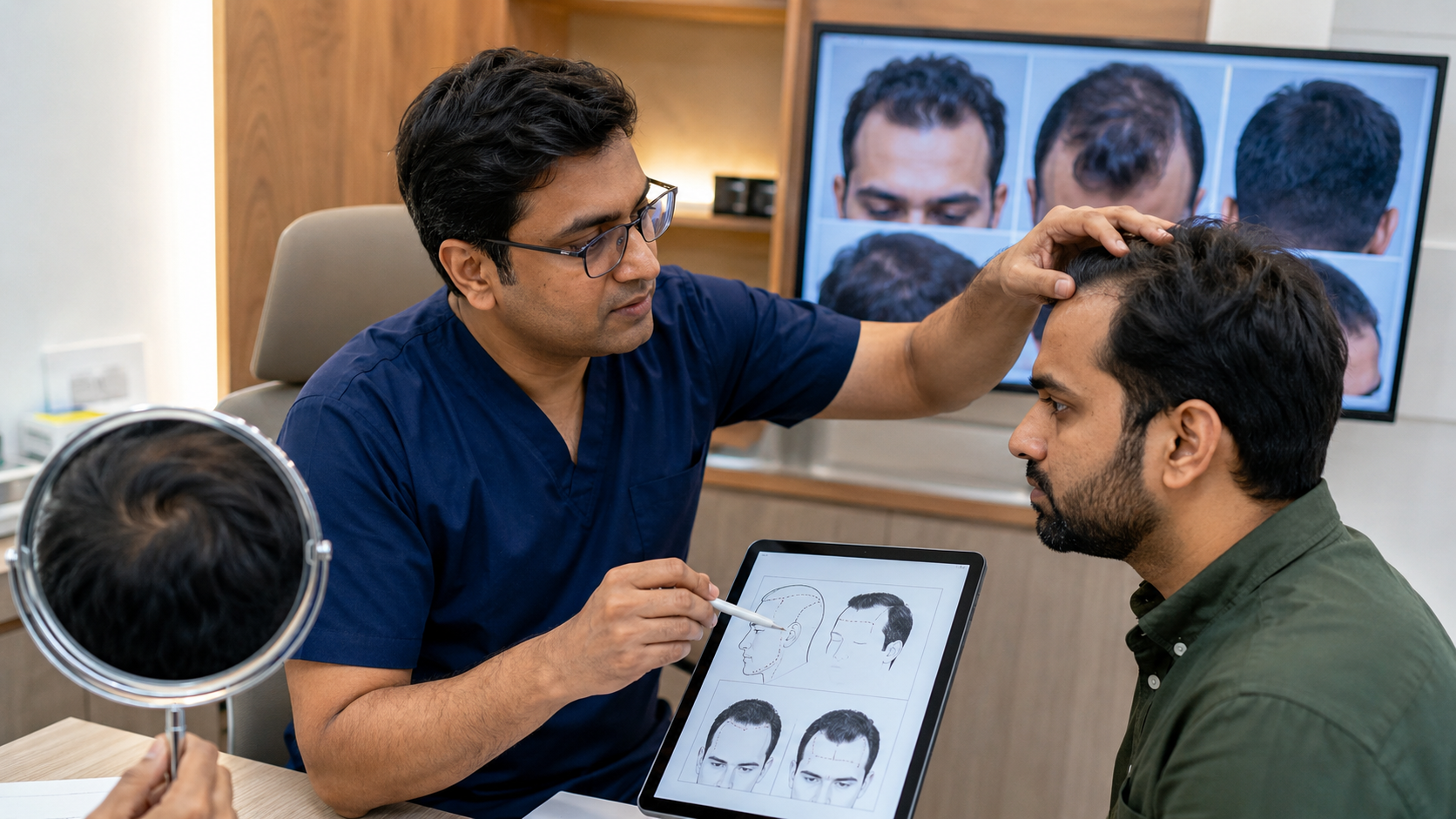
During consultation, specialists assess:
- Rate of hair loss
- Family history
- Areas of active thinning
- Existing miniaturized hairs
- Future risk of progression
The objective is to avoid creating a hairline that appears unnatural as hair loss continues.
Does Your Hair Loss Pattern Change the Timing?
Hair loss does not look the same for everyone, and the pattern itself influences both timing and surgical planning.
— A receding hairline that has stabilised is often more appropriate to plan around than active diffuse thinning, which can still be evolving across the scalp
— Crown thinning, while common, is harder to predict in its early stages and is generally approached more conservatively
— Sudden or rapid shedding may point to a separate underlying cause — stress, thyroid imbalance, or nutritional deficiency — that needs to be addressed before any transplant is considered
This is why pattern recognition, not just hair count, forms a core part of any proper pre-surgical evaluation.
Donor Area: The Foundation of Every Transplant
The donor area is often called the “hair bank.”
These follicles are genetically resistant to hair loss and are transplanted to balding areas. However, donor hair is a limited resource.
Several factors are evaluated:
- Hair density
- Hair thickness
- Curl or texture
- Scalp elasticity
- Extent of future hair loss
Men with strong donor density usually have greater flexibility in treatment planning.
Patients with advanced baldness may require strategic graft placement to balance frontal restoration with future needs.
Protecting donor reserves is essential for long-term success.
Medical Evaluation Before Surgery
A comprehensive medical assessment is an important part of treatment planning.
Conditions that may contribute to hair loss include:
- Thyroid disorders
- Nutritional deficiencies
- Scalp inflammation
- Autoimmune conditions
- Chronic stress-related shedding
Blood investigations may be recommended when indicated.
Scalp analysis helps determine:
- Hair shaft diameter
- Follicular density
- Miniaturization patterns
- Active hair loss
This evaluation ensures that surgery addresses the correct problem.
Not every patient experiencing hair loss requires a transplant immediately.
The Role of Medical Treatments
Hair transplantation and medical therapy often work together.
Medications may help:
- Slow ongoing hair loss
- Preserve existing hair
- Improve density
- Stabilize progression
For suitable patients, treatments such as oral medications, topical therapies, or regenerative procedures may be advised before surgery.
Medical stabilization can improve the predictability of surgical outcomes.
Setting Realistic Expectations
One of the most important aspects of consultation is discussing expectations.
A hair transplant can:
- Improve hair density
- Restore the hairline
- Enhance facial framing
- Create a more youthful appearance
However, it cannot:
- Recreate teenage density
- Stop future hair loss entirely
- Provide instant results
Hair growth occurs gradually.
Typical timelines include:
- Initial shedding in the first few weeks
- New growth around three to four months
- Visible improvement after six months
- Final maturation between twelve and eighteen months
Patients who understand the process generally report higher satisfaction.
So, When Is the Right Time?
The right time is when three things align: your hair loss pattern has stabilised enough to plan around, your donor area has been properly evaluated and found suitable, and your expectations are grounded in what a transplant can realistically achieve for your specific case.
This can happen at 26. It can happen at 45. Age is simply one input among several — and on its own, it tells a surgeon very little.
If you are unsure where you currently stand, that uncertainty is, in itself, a reason to seek a proper evaluation rather than guess.
Book Your Consultation at Radiant Roots for Hair Transplant in Mangalore
At Radiant Roots, hair restoration planning extends beyond the immediate appearance of bald areas.
Every consultation considers:
- Current hair loss pattern
- Future progression
- Donor preservation
- Facial proportions
- Age-related changes
- Long-term aesthetic goals
This individualized approach helps create natural-looking outcomes that continue to age well over time.
For men considering a hair transplant in Mangalore, timing the procedure correctly can make a significant difference in both short-term satisfaction and long-term results.
If you are noticing changes in your hairline or scalp and are unsure whether it is the right time to act, consider proper clinical evaluation.
There is no universal right age. There is only the right evaluation.
Frequently Asked Questions
Is there a minimum age for a hair transplant?
There is no fixed minimum age; however, top hair transplant surgeons in Mangalore are cautious about operating before the early-to-mid 20s, when hair loss patterns may still be evolving. The deciding factor is pattern stability, not a specific number.
Can a hair transplant be done if hair loss is still progressing?
It can, but the surgical plan needs to account for likely future loss — not just the current pattern. This usually means a more conservative approach, often combined with medical management to slow further thinning around the transplanted area.
What if my donor area isn't strong enough?
If donor density is limited, a surgeon may recommend a more conservative transplant plan, prioritise the most visible areas first, or suggest non-surgical treatments to support existing hair before considering surgery further.
Should I try medications before a hair transplant?
Medical treatments may help stabilize ongoing hair loss and preserve existing hair. In many cases, they are recommended before or alongside transplantation.
How long do hair transplant results last?
Transplanted follicles are generally resistant to genetic hair loss and can provide long-lasting results. However, untreated native hair may continue to thin over time, making long-term follow-up important.