Hair Transplant vs PRP: How to Know What Your Hair Really Needs
Hair loss rarely follows the same pattern for everyone. Some people notice increased shedding and thinning, while others experience a receding hairline or visible bald patches. This is why choosing between a hair transplant vs PRP isn't always straightforward. The right treatment depends on what's happening beneath the surface of your scalp.
Many patients exploring a hair transplant in Mangalore often ask the same question: "Should I try PRP first, or do I need a hair transplant?"
The answer depends on the health of your hair follicles, the stage of your hair loss, and your long-term goals. Understanding these differences can help you make a more informed decision and avoid treatments that may not suit your condition.
What Does PRP Actually Do for Hair Loss?
PRP (Platelet-Rich Plasma) is a treatment designed to support and strengthen existing hair follicles.
It uses concentrated growth factors from your own blood to:
- Improve blood circulation around hair roots
- Strengthen weakened follicles
- Support healthier hair growth
- Reduce excessive shedding
- Improve overall hair quality
However, PRP does not create new hair follicles. It can only work on follicles that are still alive and capable of producing hair.
This is one of the most important reasons why PRP results vary from person to person.
What Determines Whether PRP Will Work for You?
Are Your Hair Follicles Still Active?
The success of PRP depends heavily on the condition of your follicles.
PRP generally works best when:
- Hair is thinning but still present
- Follicles are becoming weaker, not absent
- Hair loss is in its early stages
Results may be limited when:
- Bald patches have become clearly visible
- The scalp appears smooth and shiny
- Hair follicles are no longer active
Once a follicle has stopped functioning completely, stimulation alone cannot restore it. In such situations, a hair transplant often becomes the more suitable option.
Is PRP Suitable for Your Hair Loss Pattern?
Not all hair loss behaves the same way.
PRP can be beneficial for:
- Early male pattern hair loss
- Female pattern thinning
- Diffuse thinning across the scalp
- Temporary shedding triggered by stress
PRP may be less effective when:
- Hairline recession is significant
- Crown baldness is well established
- Hair loss has progressed over several years
As hair loss advances, the goal often shifts from preserving existing hair to restoring areas where hair is no longer growing. This is where a hair transplant in Mangalore may offer a more predictable solution.
Why Does the Quality of PRP Treatment Matter?
Many people assume all PRP treatments are identical.
In reality, outcomes can vary depending on:
- Platelet concentration
- Preparation techniques
- Injection methods
- Treatment intervals
- Overall treatment planning
Two patients receiving PRP may have very different experiences based on how the procedure is performed and how well it matches their hair loss condition.
Why Do Some People Feel PRP Didn't Deliver the Results They Expected?
In many cases, PRP itself isn't the issue.
The challenge is often that the treatment was started at the wrong stage of hair loss.
Common reasons include:
- Beginning PRP after significant baldness has developed
- Expecting new growth in completely bald areas
- Inconsistent treatment schedules
- Lack of a long-term hair restoration strategy
- Unrealistic expectations
PRP works best when it becomes part of a broader hair preservation plan rather than being viewed as a one-time solution.
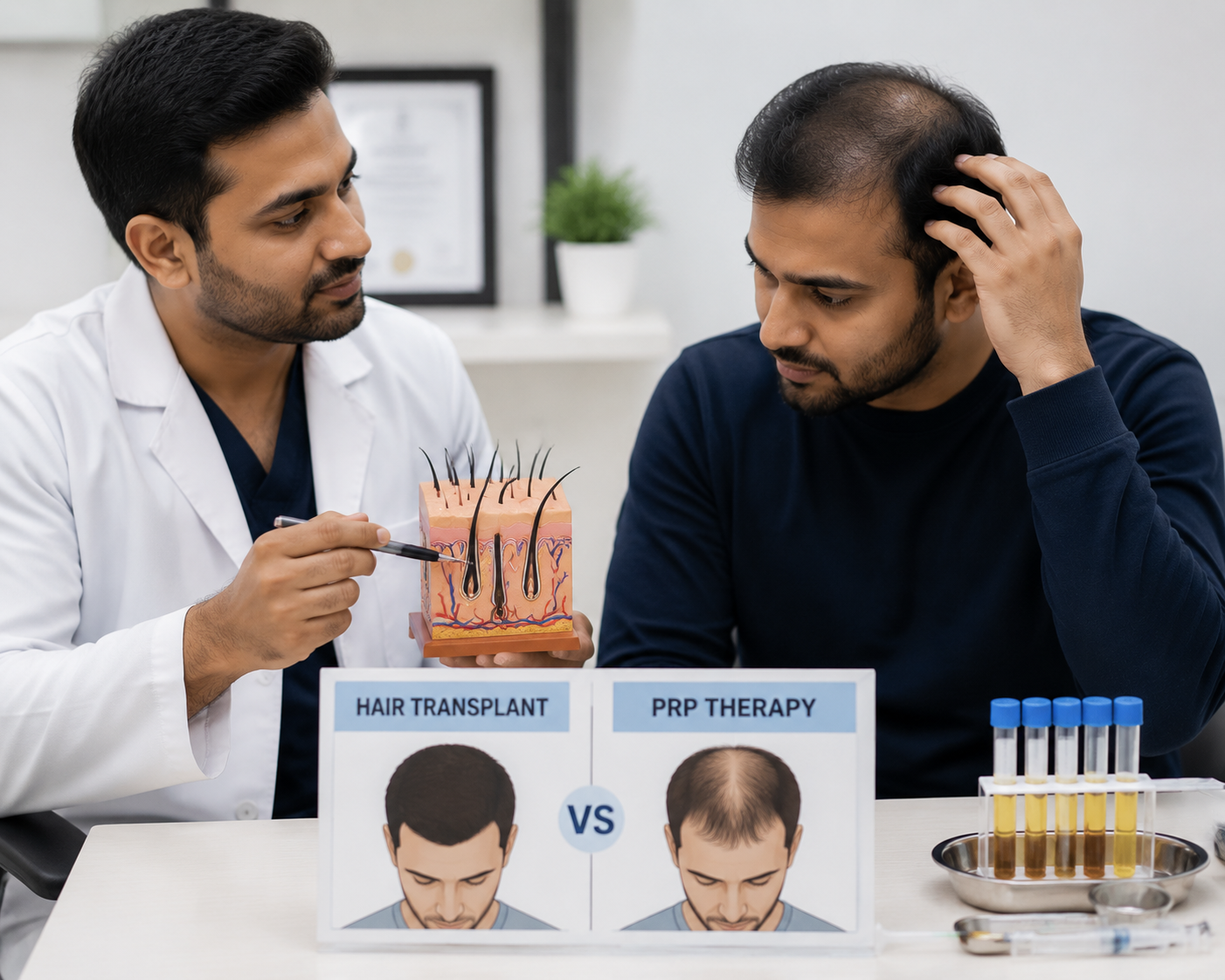
Hair Transplant vs PRP: When Does the Right Choice Change?
Understanding the purpose of each treatment makes the decision easier.
PRP Focuses On:
- Strengthening existing hair
- Improving follicle health
- Reducing hair fall
- Slowing progression of thinning
Hair Transplant Focuses On:
- Restoring hair in bald areas
- Rebuilding a receding hairline
- Improving density where follicles are absent
- Creating long-term coverage
If your primary concern is thinning hair, PRP may still be highly beneficial.
If your concern is visible baldness or a significantly receded hairline, a hair transplant often provides a more effective solution.
Can PRP and Hair Transplant Work Together?
Absolutely.
In many cases, combining both treatments provides the most balanced approach.
PRP may be used:
Before a Hair Transplant
To improve scalp health and strengthen surrounding hair.
After a Hair Transplant
To support healing and encourage healthy growth during the recovery period.
This combination approach addresses both preservation and restoration at the same time.
When Should You Consider Moving Beyond PRP?
There comes a point where reassessment becomes important.
You may benefit from exploring other options if:
- Multiple PRP sessions show little improvement
- Hair loss continues to progress steadily
- Bald areas become increasingly noticeable
- You are repeating treatments without a clear strategy
Rather than continuing the same approach indefinitely, a thorough evaluation can help determine whether a different treatment plan may provide better results.
Why Proper Diagnosis Matters More Than the Treatment Itself
One of the biggest misconceptions about hair restoration is that success depends only on choosing the right procedure.
In reality, success starts with understanding your condition.
A proper assessment helps determine:
- Your pattern of hair loss
- Follicle health
- Donor area quality
- Future hair loss progression
- Long-term restoration goals
This allows treatment decisions to be based on evidence rather than assumptions.
What Do Realistic Hair Restoration Results Look Like?
When the treatment matches the condition, results tend to be far more satisfying.
PRP can help:
- Improve hair thickness
- Reduce shedding
- Support healthier growth
A hair transplant can help:
- Restore lost hairlines
- Rebuild crown density
- Create natural-looking coverage
When used appropriately, both treatments can play valuable roles in achieving long-term, natural-looking outcomes.
The Right Hair Solution Starts With Understanding Your Hair Loss
The discussion around hair transplant vs PRP isn't about deciding which treatment is superior. It's about identifying which treatment is most suitable for your current stage of hair loss.
PRP can be highly effective when follicles are still active and thinning is in its early stages. A hair transplant becomes more relevant when hair loss has progressed and restoration is needed.
Understanding your hair loss pattern early allows you to make informed decisions and build a treatment plan that supports both your current concerns and long-term goals.
If you're considering a hair transplant in Mangalore or exploring PRP as part of your hair restoration journey, a professional assessment can provide valuable clarity. Under the guidance of Dr. Chandra, an experienced hair transplant surgeon, patients at Radiant Roots receive personalized recommendations based on their unique hair loss pattern, helping them choose the approach that offers the most natural and lasting results.
FAQs
How many PRP sessions are usually needed for hair loss?
Most patients require a series of 3–6 sessions followed by maintenance treatments. The exact number depends on the stage of hair loss and follicle health.
Can PRP regrow hair in completely bald areas?
No. PRP works by stimulating existing follicles. Areas where follicles are no longer active generally require a hair transplant for visible restoration.
How can I tell if PRP is working?
Reduced hair shedding, improved thickness, and healthier hair quality are common signs. Visible improvements usually become noticeable over several months.
Is a hair transplant better than PRP?
Neither treatment is universally better. PRP helps preserve existing hair, while a hair transplant restores hair in areas where it has already been lost.
Can PRP be done after a hair transplant?
Yes. PRP is often used after transplantation to support healing, strengthen surrounding hair, and encourage healthy growth.
How do I know whether I need PRP or a hair transplant?
The answer depends on your hair loss stage, follicle health, and treatment goals. A detailed consultation helps determine which option is best suited to your needs.