How Many Grafts Do I Need For A Full Head of Hair?
As a hair restoration surgeon, one of the most frequent questions I receive during initial consultations is, "Doctor, how many grafts will I need?"
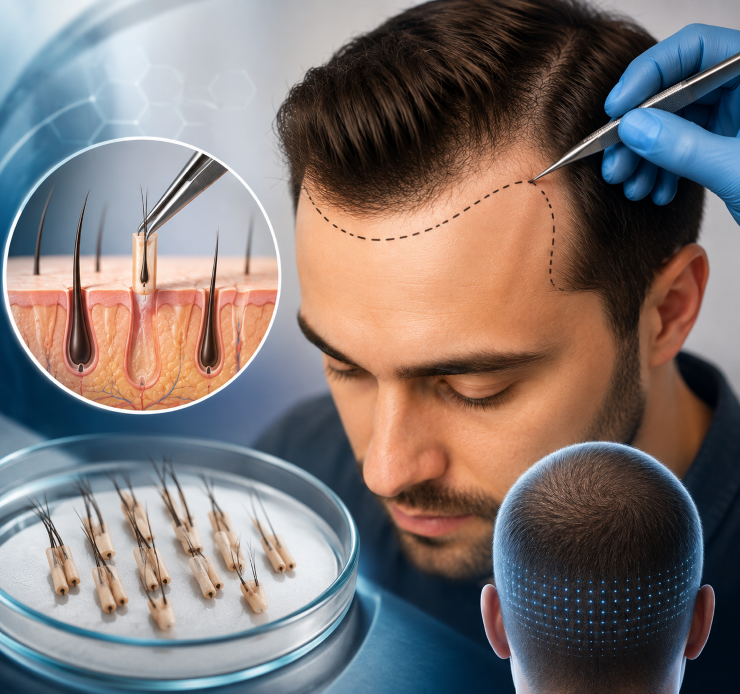
To understand the answer, we must first define a graft. A follicular unit graft is a naturally occurring microscopic grouping of one to four hairs. The total number of grafts needed for a full head of hair depends on the pattern of hair loss, donor density, hair thickness, scalp visibility, the area being treated, future hair loss, and the amount of donor hair that can be used responsibly.
Every scalp possesses a finite number of lifetime donor hairs. Therefore, determining your exact graft count is not a matter of guesswork; it is a strict surgical calculation designed to maximize coverage while preserving the natural appearance of your donor zone.
Understanding how the calculation is made can help set more realistic expectations before an FUE hair transplant.
What Exactly Is a Hair Graft?
A graft is not the same as a single strand of hair.
Hair naturally grows from the scalp in small groups known as follicular units. One follicular unit may contain 1-3, or sometimes more hairs.
During FUE, these follicular units are removed individually from a suitable donor area and placed into planned recipient sites.
This distinction matters because:
- 1,500 grafts does not mean 1,500 hairs
- Some grafts contain a single hair
- Others contain multiple hairs
- The mix of graft types affects how the available hair can be distributed
For example, single-hair grafts may be useful around parts of a hairline, while grafts containing more hairs can contribute to coverage farther behind it.
How Do Doctors Calculate the Number of Grafts for a Hair Transplant?
There is no single graft calculator that works accurately for everyone.
A clinical assessment usually looks at several factors together.
The 4 Biological Factors that Impact Graft Count
To map out your procedure, we analyze four distinct medical factors:
- Your Hair Loss Stage: We use the Norwood Scale (for men) or Ludwig Scale (for women) to measure the total surface area of your thinning zones.
- Donor Zone Supply: We inspect the permanent hair at the back of your head. We check its density and follicle strength.
- Hair Texture: Coarse, curly hair covers more scalp area visually. Fine, straight hair requires more grafts to achieve the same look of fullness.
- Age & Anatomy: We design a mature, natural hairline that matches your facial bone structure as you age.
Hair Transplant Graft Calculation
In practice, a hair transplant surgeon maps the treatment by:
Baldness area + thinning aspect+ desired density + hair characteristics + donor capacity = realistic graft requirement
| Norwood Scale Stage | Severity of Hair Loss | Estimated Graft Required | Primary Treatment Areas |
| Stage 2 | Minor recession | 500 – 1,000 grafts | Receding temples only |
| Stage 3 | Deepening recession | 1,000 – 1,500 grafts | Temples and frontal hairline |
| Stage 4 | Advanced frontal & crown loss | 1,500 – 2,500 grafts | Hairline, mid-scalp, or early crown |
| Stage 5 | Vertex and frontal merging | 2,500 – 3,500 grafts | Extensive frontal and crown coverage |
| Stage 6 & 7 | Severe, widespread hair loss | 3,500 – 5,000+ grafts | Maximum restoration / Multi-session strategy |
Understanding Area-Wise Graft Requirement
The number of grafts for a hair transplant depends on the location and extent of thinning. Approximate requirements may include:
Hairline and frontal zone
The hairline and frontal scalp commonly require around 1,000–2,000 grafts, depending on recession, hairline design, temple loss, and existing density. Single-hair grafts may be used along the front edge for a natural appearance.
Mid-scalp
The mid-scalp sits between the frontal region and the crown.
Thinning across the mid-scalp may require approximately 800–1,500 grafts. The estimate depends on the size of the area, remaining native hair, and whether treatment is combined with the frontal region.
Crown or vertex
A crown procedure may require around 800–1,500 grafts. Because the crown follows a spiral growth pattern and can cover a broad area, complete coverage may require more grafts than expected.
Extensive thinning
When the hairline, frontal scalp, mid-scalp, and crown are affected, the total requirement may range from approximately 2,500–4,500 grafts or more. However, donor hair may need to be prioritised rather than distributed evenly across every area.
These figures are general estimates, not fixed treatment recommendations. The final graft count depends on scalp area, hair thickness, graft composition, donor density, hair-to-scalp contrast, and future hair loss. A personalised clinical assessment is necessary for accurate planning.
Does the Norwood Scale Tell You How Many Grafts You Need?
Not by itself.
The Norwood-Hamilton scale is commonly used to describe patterns of male androgenetic hair loss. It can help a doctor understand how far the pattern has progressed.
However, a Norwood stage does not provide an exact graft requirement.
Why not?
Two people classified within the same stage may have very different:
- Head sizes
- Hairline shapes
- Crown sizes
- Donor densities
- Hair thicknesses
- Hair textures
- Amounts of existing hair
One person may mainly need planning around the frontal area. Another person at a similar stage may have significant thinning through the mid-scalp as well.
So, while the Norwood scale gives useful clinical context, it should not be used as a stand-alone graft calculator.
The Donor Area Can Set the Limit
Hair transplant surgery can only redistribute hair that is available.
That makes the donor area one of the most important parts of graft planning.
Before deciding a graft number, the donor area may be checked for:
- Follicular-unit density
- Number of hairs per follicular unit
- Hair thickness
- Miniaturisation
- Previous extraction marks
- Scarring
- Scalp disease
- Overall stability of the donor zone
With FUE, follicular units are removed individually. Excessive extraction can reduce donor density and may produce visible thinning or scarring.
Hair-transplant practice guidelines therefore specifically advise avoiding overharvesting.
This means the question should not simply be:
“How many grafts can be taken?”
A more useful question is:
“How many grafts can be planned responsibly while considering the donor area and possible future needs?”
How Is Graft Planning Different in an FUE Hair Transplant?
In an FUE hair transplant, follicular units are extracted one at a time using small punches.
This allows grafts to be selected and distributed across the donor region, but it does not make the donor supply unlimited.
Planning therefore involves two sides of the scalp at the same time:
Recipient-side planning
The doctor considers:
- Where coverage is needed
- Existing hair density
- Hairline design
- Direction of existing hair
- Surface area
- Appropriate graft distribution
Donor-side planning
The doctor considers:
- Available follicular units
- Safe extraction pattern
- Hair calibre
- Donor density
- Signs of miniaturisation
- Previous procedures
- Need to retain donor coverage
Both sides must make sense together.
How Is the Number of Grafts for a Hair Transplant Decided?
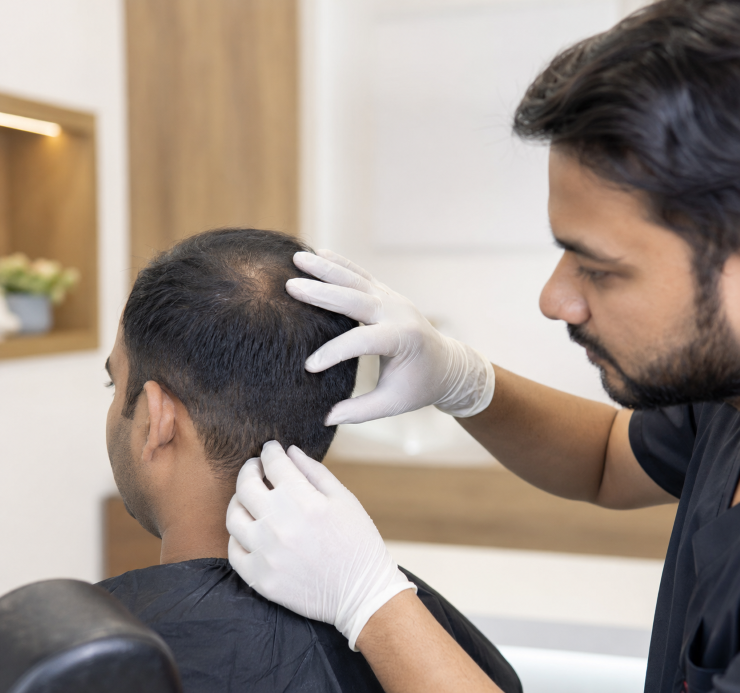
For someone exploring a hair transplant in Mangalore or elsewhere, a graft estimate should ideally follow a complete scalp and hair-loss assessment rather than being given from photographs alone.
A proper evaluation may include:
- Identifying the type and pattern of hair loss
- Mapping the recipient area
- Assessing existing hair within that area
- Measuring or examining donor density
- Checking hair calibre and follicular-unit composition
- Looking for donor miniaturisation
- Reviewing previous hair procedures
- Considering age and likely future hair loss
- Reviewing relevant medical history
- Discussing realistic limitations of the available donor supply
Not every person with hair loss is automatically suited to transplantation. The diagnosis and donor assessment come before the graft count.
The Graft Number of Grafts Needed for a Full Head of Hair Is a Plan, Not a Target
It is understandable to want a number before considering a hair transplant. But the most useful graft estimate is not the highest number or the number shown by any online calculator.
It is the number that makes sense after examining the recipient area, donor reserve, hair characteristics, current pattern of loss, and possible future thinning.
A personalised assessment can determine whether transplantation is suitable and how graft distribution may be planned. Individual results vary, and a graft number should never be interpreted as a promise of a particular level of coverage or outcome.
Author
Dr. Chandra
Board-certified Plastic and Cosmetic Surgeon (MCh)
The Lead Surgeon at Radiant Roots Hair Transplant & Aesthetic Surgery Centre, Mangalore.
Frequently Asked Questions
Can the exact number of grafts be decided from a photograph?
A photograph can show the general pattern of thinning, but it cannot reliably measure donor density, hair calibre, miniaturisation, or follicular-unit composition. A clinical scalp assessment provides more information.
Why can two people with the same baldness stage need different graft numbers?
Their recipient areas, donor density, hair thickness, scalp size, existing hair, and future hair-loss patterns may differ. Baldness stage is only one part of the calculation.
Can all required grafts always be taken in one FUE session?
Not necessarily. The amount that can be harvested should depend on donor characteristics, extraction pattern, procedure planning, and individual circumstances rather than a predetermined target.
Does a high graft count guarantee greater density?
No. Graft count alone cannot guarantee density or a particular cosmetic result. Hair calibre, hairs per graft, recipient area, placement, existing hair, donor capacity, and individual healing also matter.
Does the crown usually need different planning from the hairline?
Yes. The crown has a circular or whorl pattern and can cover a relatively large surface area. Its planning differs from the frontal hairline, where direction, irregularity, and the use of suitable follicular units are especially important.
This content is for general educational purposes and does not constitute medical advice. Individual results vary. Please consult a qualified medical practitioner for a personalised assessment.