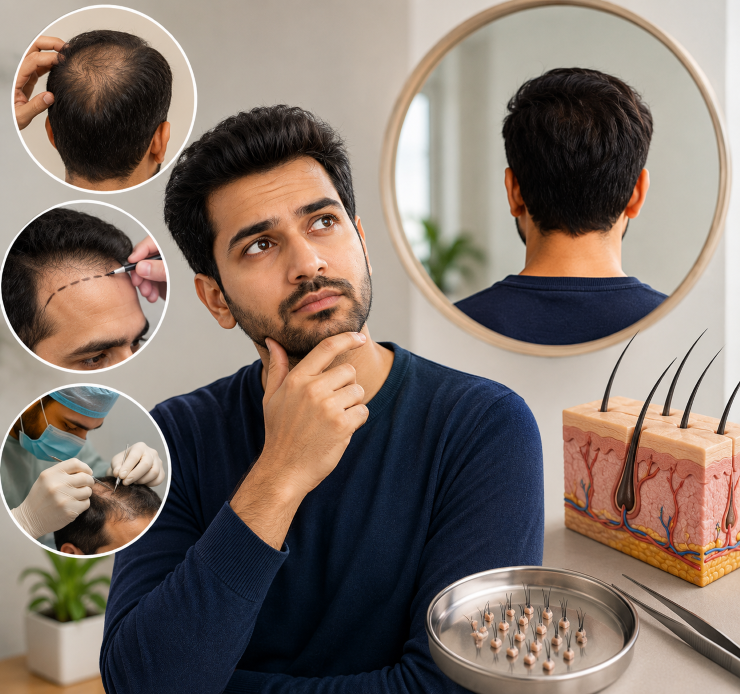
Hair Transplant Myths That Keep People From Seeking a Consultation
Many people delay seeing a doctor about hair loss, even when it bothers them daily. Often, it isn't the hair loss itself that holds them back but the doubt around what a transplant actually involves. Will it look natural? Will it last? Is it only for people who are already very bald? These doubts, usually based on outdated information, are enough to stop someone from booking a simple consultation.
In our practice, we hear these worries on almost every first visit, whether someone is exploring hair transplant in Mangalore for the first time or has been putting it off for years. This blog goes through the most common myths, with the facts as they stand today. Individual results may vary from person to person, and nothing here replaces an in-person check-up. But it should help you walk in with clearer questions.
The One Concept That Explains Most of These Myths
Before we get to the myths, here's one simple idea worth knowing: donor dominance.
Hair follicles carry their own "memory" of where they came from. Hair at the back and sides of the scalp is naturally less sensitive to DHT, a hormone that causes most common hair loss. A hair transplant simply moves these follicles to a thinning area. The follicles keep behaving like they did in their old spot, not the new one. This one fact is really the whole basis of the surgery.
It also explains why so many myths still exist. Hair transplant surgery has been around since the 1950s. But for decades, it used punch grafts and plugs of hair that looked patchy and unnatural. A lot of what people "know" about hair transplants today is really a memory of that old method. That method is barely used anymore.
Myth 1: "Transplanted hair looks fake or unnatural"
Hair transplant may look fake or unnatural if the implanted hair is not placed properly. Modern FUE (Follicular Unit Extraction) works differently:
- Small groups of one to four hairs are removed and placed one at a time
- Each of the hair is placed to match up with the direction, density, and angle of your natural hair
- A well-planned hairline helps the result blend in, instead of standing out
- The final look still depends on planning and your own hair type, so results can vary from person to person
Myth 2: "Results are instant"
One must not expect results of hair transplant in the same month. Here is the timeline your body actually goes through:
- Weeks 1 to 3: The transplanted hair often falls out. This is called "shock loss," and it's expected. Do not think that the transplant failed.
- Months 3 to 4: New, thin hair starts to grow from the transplanted follicles.
- Months 6 to 9: Hair becomes visibly thicker and longer.
- Months 12 to 15: This is usually when the final result is visible.
So the real "before and after" should be compared at around a year, not in a month.
Myth 3: "One transplant session fixes any amount of hair loss"
- The number of grafts needed depends on how much hair is lost and how large the area is
- Someone with early thinning may need far fewer grafts than someone with more advanced baldness
- There is also a safe limit to how many grafts can be moved in a single sitting. Trying to place too many grafts too close together can reduce blood supply to that part of the scalp, which can affect how well the grafts survive
- The donor area itself has a limited supply of hair, and it does not grow back once used. Surgeons plan extraction carefully so that enough healthy donor hair is preserved for the future, in case it's ever needed again
- For more extensive hair loss, the first sitting may focus on areas like the hairline and mid-scalp, with the crown addressed in a later sitting once the scalp has healed
In some cases, a second sitting is planned in advance. This is decided only after a scalp check-up, not before, and individual results may vary from person to person.
Myth 4: "Hair Transplant is only for men"
- Women get hair thinning too, though the pattern is usually different, they are more spread-out thinning on the crown, rather than a receding hairline
- Women can also be considered for a hair transplant, depending on the type and cause of their hair loss
- A proper diagnosis matters here, since some causes of hair loss in women need to be checked medically first, before deciding on surgery
Myth 5: "Hair transplants aren't really permanent and hair falls out eventually anyway"
This myth often comes from a simple mix-up: confusing everyday hair shedding with the transplant failing. Here's the honest picture:
- Transplanted hair comes from the back and sides of the scalp, an area that is naturally resistant to the hormone behind common pattern hair loss
- Because of this, transplanted hair is generally resistant to the original pattern of loss that affected the rest of the scalp
- Everyone naturally sheds hair every single day as part of the normal hair growth cycle. On average, people lose 50 to 100 hairs a day as older hairs are replaced with new ones and this applies to transplanted hair too, once it has fully grown in
- Seeing a few loose strands in the shower or on your comb months or years later is part of this normal cycle, not a sign that the transplant has failed
- "Permanent" does not mean immune to everything, though. Age, general thinning over the years, illness, or other causes can still affect any hair, transplanted or not
- A transplant also does not stop hair loss from continuing in areas that were not treated
Myth 6: "Hair transplant surgery is painful"
On the day of surgery:
- FUE is done under local anaesthesia. You stay awake and comfortable, not put to sleep
- Most patients go home the same day
- Mild swelling, scabbing, or tightness in the first week is normal, not a warning sign
- Most people do start with light work within 3 to 7 days
Like any surgery, it does carry some risk. This may include:
- Temporary swelling or numbness of the scalp
- Itching or small scabs at the treated spots
- Mild scarring in the donor area
Serious problems are rare when the surgery is done correctly. But no surgery is completely risk-free, and this should always be discussed with your surgeon.
Recovery is usually simple. It means gentle scalp care, staying out of direct sun, avoiding hard exercise for a short time, and following specific after care hair transplant guidelines.
A Combined Approach: PRP and Hair Transplant Together
PRP and a hair transplant are sometimes seen as competing options, but in practice, they often work well alongside each other:
- PRP and a hair transplant solve different problems. PRP works on hair that is thinning but still alive, helping slow down loss or support existing growth. A transplant moves living follicles into an area where hair has already stopped growing
- The two are often used together rather than as either/or choices. PRP is sometimes used before a transplant to support the scalp, and afterward to support the transplanted grafts as they settle in
- For patients who are unsure about surgery, starting with PRP is a reasonable first step. A transplant can still be considered later if hair loss continues or if it's still needed
- Which approach makes sense - PRP alone, a transplant alone, or a combination of the two depends on your hair loss pattern and scalp condition, and this is decided only after a proper check-up
| Aspect | Hair Transplant | PRP Therapy |
| Type of treatment | Surgical, usually one-time (sometimes staged) | Non-surgical, repeated sessions |
| Best for | Bald or thinning patches with stable donor hair | Early thinning, supportive care |
| When change is visible | Gradual, over 9–15 months | Gradual, needs regular sessions |
| Ongoing effort needed | Usually a single procedure | Needs repeat sessions to maintain effect |
| Downtime | A few days | Little to none |
This is a general comparison. The right option, or combination, depends entirely on your own scalp condition, which only a proper check-up can tell you.
A note before we go further: This blog is meant purely to inform and educate readers on common misconceptions around hair transplantation. It is not intended to promote a specific treatment path, and it should not replace a personalised, in-person medical assessment. Consult your hair transplant doctor in Mangalore to understand what is ideal for your condition.
Check Facts Over Myths Before Any Treatment
What actually matters is your own scalp, your own pattern of hair loss, and your own health and not a friend's story or something read on a forum. Every case is different, and how well a treatment works depends entirely on your individual scalp condition.
If any of this sounds like what you're going through, it helps to speak with a qualified doctor who can guide you based on your own case, rather than going by assumptions or general information alone.
Author:
Dr. Chandra
Board-certified Plastic and Cosmetic Surgeon (MCh)
Lead Surgeon at Radiant Roots Hair Transplant & Aesthetic Surgery Centre, Mangalore.
Frequently Asked Questions
Q1) Is it safe to get a hair transplant?
When performed by a qualified surgeon in a proper clinical setting, it is considered a safe, minor surgical procedure. Individual suitability still depends on your health history and scalp condition.
Q2) Can I go back to work right after the procedure?
Most patients return to light, non-strenuous work within 3 to 7 days. Physically demanding activity is usually paused for a few weeks, as advised by your surgeon.
Q3) How many sessions does it usually take?
Many patients need only one session. Extensive hair loss may require a second sitting, planned only after examining your scalp.
Q4) Will transplanted hair need different styling?
No. Once grown in, it can generally be cut, styled, and washed just like your natural hair.
Q5) Does it stop future hair loss in untreated areas?
No. It only restores hair in the transplanted area. Loss in other parts of the scalp may continue and might need separate evaluation.
Q6) Is the result really permanent?
Transplanted hair comes from an area generally resistant to the hormone behind common pattern hair loss, so it tends to hold up well long-term. No medical outcome can be called permanent in an absolute sense, since ageing and other factors can still affect hair over time.
Disclaimer: This content is for general educational purposes only and does not constitute medical advice. Outcomes vary between individuals. Please consult your treating doctor for a personalised assessment before starting any treatment.