Hair Transplant vs. Non-Surgical Hair Regrowth Options — How to Decide What’s Right for You
When hair starts thinning excessively, one of the first questions is often: Should I get a hair transplant, PRP therapy for hair growth, or something else?
There is no single answer that suits everyone.
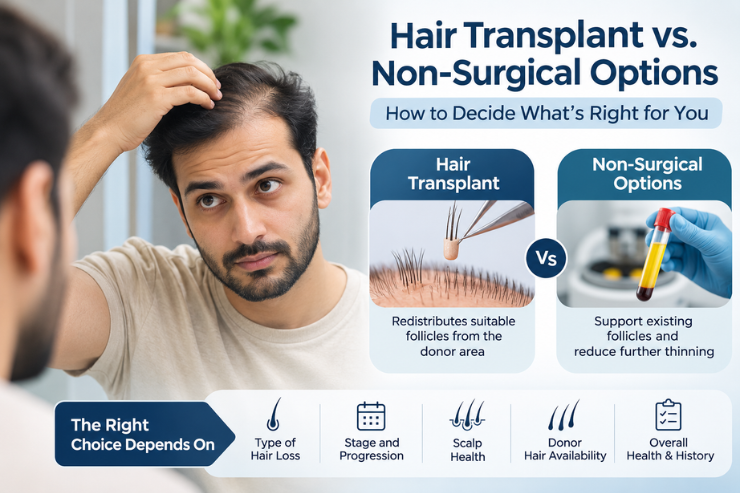
A hair transplant moves existing hair from a suitable donor area to an area where hair has been lost. Non-surgical treatments work differently. Depending on the cause of hair loss, they may aim to support existing follicles, reduce ongoing thinning, or improve the environment around follicles that are still present.
So, choosing a hair loss treatment starts with understanding what is happening to the hair—not with choosing a procedure.
Start With the Diagnosis, Not the Treatment
Hair loss is not one condition.
Pattern hair loss, sudden shedding, patchy hair loss, inflammatory scalp disorders, nutritional problems, and scarring forms of hair loss can all look different and require different approaches.
The first assessment may therefore include:
- Pattern and duration of hair loss
- Rate of progression
- Family history
- Scalp health
- Hair miniaturisation
- Donor-area density
- Medical history
- Current medicines
- Recent illness, weight change, or stress
- Previous hair treatments
This matters because a hair transplant is not appropriate for every type of hair loss. Current clinical guidance also stresses identifying the type of alopecia and assessing whether the pattern is sufficiently stable before transplantation is considered.
Hair Transplant vs PRP: What Is the Main Difference?
The easiest way to understand hair transplant vs PRP is to look at what each treatment is designed to do.
| Treatments | Main purpose | Most relevant when |
| Hair transplant | Redistributes suitable follicles from the donor area | An area has established hair loss and adequate donor hair is available |
| PRP | Uses components from the patient’s own blood as a regenerative treatment | Existing follicles are still present and thinning |
| Topical approaches | May help support or maintain existing hair in selected types of hair loss | Hair is miniaturising rather than completely absent |
| Lifestyle or medical correction | Addresses contributing factors where present | Hair loss is linked to an underlying trigger or condition |
The important point is that these options are not always interchangeable.
When Do Non-Surgical Hair Loss Treatment Options Make More Sense?
Non-surgical management is often considered when follicles are still present.
Early or progressive thinning
If a person notices widening of the parting, reduced volume, a receding hairline, or gradual thinning—but still has a reasonable amount of existing hair—preserving those follicles may become the immediate priority.
Depending on the diagnosis, management may include:
- Doctor-prescribed topical approaches
- PRP in selected cases
- Correction of relevant nutritional or medical factors
- Scalp-condition management
- Monitoring the progression of hair loss
Early assessment can be useful because once a follicle has been lost completely, non-surgical treatment cannot simply create a new follicle.
When hair loss is still changing rapidly
A rapidly changing hairline or expanding area of thinning deserves careful evaluation.
Planning surgery too early without considering future progression may result in transplanted hair remaining while the untreated surrounding hair continues to thin.
This is why long-term planning matters, particularly in younger patients.
What Can PRP Actually Do?
PRP stands for platelet-rich plasma.
A small amount of the patient’s blood is processed to concentrate a plasma fraction containing platelets. This is then administered into selected areas of the scalp.
Research suggests that PRP may improve measures such as hair density in some people with androgenetic or pattern hair loss. However, studies use different preparation methods, treatment schedules, and assessment methods, so responses are not uniform. A systematic review found encouraging results but also highlighted variation between studies and limitations in the quality of evidence.
More recent evidence continues to support a possible role for PRP while showing that protocols and outcomes remain variable.
What PRP does not do
PRP should not be viewed as a way to transplant new follicles into an area where they are absent.
It may be considered when viable follicles remain, but it cannot replace the basic function of hair transplantation.
Maintenance sessions may also form part of some PRP plans. The need and schedule vary from person to person.
When May a Hair Transplant Be Considered?
A hair transplant becomes a different conversation when hair loss is established and the scalp has an adequate, stable donor area.
In FUE, suitable follicular units are removed individually from the donor region and placed into planned recipient sites.
Assessment before transplantation usually considers:
- Whether the diagnosis is suitable for surgery
- Stability of the hair-loss pattern
- Donor density and hair calibre
- Size of the recipient area
- Existing miniaturised hair
- Future hair-loss risk
- Age
- Previous procedures
- Scalp health
- Realistic expectations
Importantly, transplantation redistributes hair; it does not stop the biological process causing future loss in non-transplanted hair.
That is why some people may still require ongoing non-surgical management even after surgery.
Does the Stage of Hair Loss Affect the Choice?
Yes. A simple way to think about choosing a hair loss treatment is by asking what needs to be achieved at the current stage.
Early thinning with many existing hairs
Primary concern: Preserve and support existing follicles.
Non-surgical approaches may be considered after diagnosis.
Moderate thinning with miniaturised hair
Primary concern: Determine which follicles may still respond and whether hair loss is continuing.
A combination or staged plan may sometimes be considered rather than immediately choosing one approach.
Established bald areas
Primary concern: There may be few useful follicles left within the affected area.
If the pattern is suitable and donor hair is adequate, transplantation may be discussed as a way to redistribute existing donor follicles.
Sudden, diffuse, patchy, or inflamed hair loss
Primary concern: Find the cause.
A transplant should not be the starting point until the underlying type of hair loss has been assessed.
Can Hair Transplant and Non-Surgical Treatment Be Used Together?
Sometimes, yes—but they serve different purposes.
For example, surgery may address an established area of loss while non-surgical management is used to support existing non-transplanted hair elsewhere.
PRP has also been studied alongside hair transplantation, although protocols differ and it should not be presented as a guarantee of better surgical outcomes. Hair-transplant guidelines discuss PRP as an adjunct rather than a replacement for appropriate surgical planning.
The decision should depend on the diagnosis rather than automatically combining multiple treatments.
The Right Choice Starts With the Right Question
The decision is not simply hair transplant vs PRP or surgical versus non-surgical treatment.
The more useful question is:
“At this stage of my hair loss, are we trying to preserve existing follicles, investigate an active problem, or redistribute hair into an area where follicles have already been lost?”
That distinction can make choosing a hair loss treatment much clearer.
Non-surgical hair loss treatment options and hair transplantation each have specific roles. Neither should be recommended solely on the basis of photographs, age, or a desired graft number.
Individual responses and outcomes vary. A qualified medical practitioner should assess the type and progression of hair loss, scalp health, donor area, medical history, and treatment goals before preparing a personalised plan.
Author
Dr. Chandra
Board-certified Plastic and Cosmetic Surgeon (MCh)
The Lead Surgeon at Radiant Roots Hair Transplant & Aesthetic Surgery Centre, Mangalore.
Frequently Asked Questions
Is PRP better than a hair transplant?
Neither is universally better. They address different situations. PRP may be considered where viable follicles remain, while a transplant redistributes suitable donor follicles into selected areas of established loss.
Can PRP regrow hair on a completely bald area?
PRP relies on the presence of follicles that can potentially respond. It does not create new follicles where they are absent.
Can non-surgical treatment prevent the need for a transplant?
That cannot be predicted for every person. In some types of progressive hair loss, non-surgical management may help maintain existing hair. The response and long-term course vary.
Does a hair transplant stop future hair loss?
No. Transplantation does not necessarily prevent untreated native hair from continuing to thin. Long-term planning should account for future progression.
When is the right time to consider a hair transplant?
There is no universal age or stage. Diagnosis, stability of hair loss, donor availability, scalp health, future progression, and individual goals all matter.
This content is for general educational purposes and does not constitute medical advice. Individual results vary. Please consult a qualified medical practitioner for a personalised assessment.