Smile Lines Deepening Year After Year? Botox and Fillers Explained
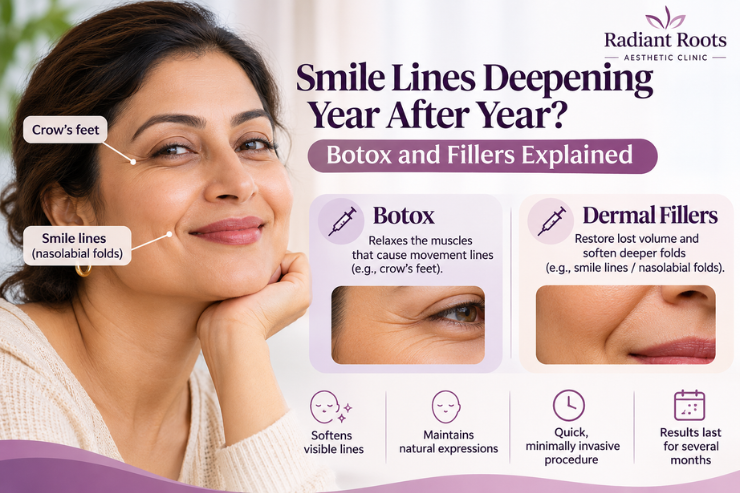
Do the lines around your mouth or eyes look deeper in photos than they did a few years ago? You are not alone, and it is a normal part of ageing. Yet many people choose a treatment without knowing which lines it actually works on. Here is the short answer: Botox relaxes the muscles behind movement lines, while dermal fillers restore lost volume in folds. Knowing your wrinkle type helps you choose with clarity.
Why Do Smile Lines Get Deeper With Age?
Smile lines are a natural sign of a face that has laughed, talked, and expressed itself for years. Over time, a few quiet changes happen beneath the skin:
- Collagen and elastin decrease, so the skin becomes less firm and springy.
- Fat pads in the cheeks thin and slowly move downward.
- Repeated expressions leave creases that begin to stay.
- Sun exposure, smoking, and large weight changes can speed up these changes.
One point often surprises patients. The words "smile lines" can describe two different areas of the face, and each has a different cause.
| Area | What people call it | Main cause |
| From the sides of the nose to the corners of the mouth | Smile lines or laugh lines (nasolabial folds) | Volume loss and looser skin |
| Outer corners of the eyes | Crow's feet | Muscle movement when you smile |
Dynamic vs Static Wrinkles: What Is the Difference?
This difference is the key to understanding which treatment may suit which line.
| Wrinkle type | When you see it | Common examples |
| Dynamic | Only when your face moves | Frown lines, forehead lines, crow's feet |
| Static | Even when your face is relaxed | Nose-to-mouth folds, deep set-in lines |
Over many years, a dynamic line can slowly turn into a static one.
A simple mirror check: relax your face completely and look closely. If the line fades, it is likely dynamic. If it stays, it may be static. Please treat this only as a rough guide. A face-to-face assessment gives a clearer picture.
Can Botox Treatment in Mangalore Treat Smile Lines?
Botox is a purified form of botulinum toxin type A. Very small amounts are injected into chosen facial muscles to temporarily relax them. With less muscle pull, the line above softens. It does not add volume or fill the skin, and your sense of touch in the area stays normal.
So whether it helps depends on which smile lines you mean:
- Crow's feet (around the eyes): These come from muscle movement. Botox is commonly used for this area.
- Nose-to-mouth folds: These come mainly from volume loss, not muscle pull. So they are generally not a Botox concern. Relaxing the muscles near the mouth may also affect how you smile and speak.
Many patients worry about looking "frozen". The aim is to relax only selected muscles, so natural expressions can remain. Research supports this careful, targeted approach. Each face responds a little differently, so results vary from person to person.
Many people who read about Botox Treatment in Mangalore are actually thinking of their nose-to-mouth folds. Knowing this difference early helps you ask the right questions and set realistic expectations.
What Do Dermal Fillers Do for Smile Lines?
Dermal fillers are soft gels placed beneath the skin to restore lost volume. For nose-to-mouth folds, this is the concern they are designed to address.
- Hyaluronic acid (HA) is the most commonly used type. Your body naturally makes HA.
- Results are usually visible soon after the procedure.
- HA fillers can be dissolved with an enzyme if needed.
- The aim is to soften a fold, not remove it. A gentle fold is part of every natural face.
Studies comparing several types of fillers for nose-to-mouth folds have found hyaluronic acid to be a safe option for softening them. How much a fold softens still differs from one person to another.
Botox vs Dermal Filler in Mangalore: Which Concern Fits?
Patients exploring Botox or a dermal filler in Mangalore often find this side-by-side view helpful.
| Point | Botox | Dermal filler (HA) |
| Works on | Dynamic lines | Static folds and volume loss |
| How it works | Relaxes a muscle | Adds volume under the skin |
| Common areas | Forehead, frown lines, crow's feet | Nose-to-mouth folds, cheeks, lips |
| When change shows | Usually within a few days to about 2 weeks | Usually soon after, once swelling settles |
| Reversible? | Wears off naturally | Can be dissolved |
| Downtime | Usually minimal | Usually minimal, with some swelling |
Some faces show both types of lines. In such cases, the two may be used in different areas of the same face. Whether this suits you is decided only after an individual assessment.
How Long Do Botox and Filler Results Last?
Both fade gradually as the body naturally works through them.
| Treatment | Usual duration* |
| Botox | About 3 to 4 months, sometimes longer |
| Hyaluronic acid filler | About 4 to 12 months, depending on the product and area |
*These are general ranges. Individual results vary from person to person.
A few factors can change how long results last:
- Age and skin quality
- Strength of the treated muscle
- How quickly your body breaks down the product
- Sun exposure and lifestyle habits
According to research, repeated Botox treatment may gradually thin the treated muscle, which can help results last a little longer for some people.
What Are the Side Effects of Botox and Fillers?
Most side effects are mild and settle on their own. It still helps to know what is possible before you decide.
| Side effect | Botox | Dermal filler |
| Swelling, redness, soreness | Common, short-lived | Common, short-lived |
| Bruising | Possible, usually fades in about a week | Possible |
| Mild headache | Uncommon | Not typical |
| Temporary droopy brow or eyelid | Rare | Not typical |
| Small lumps or unevenness | Not typical | Possible |
| Filler entering a blood vessel | Not applicable | Rare, but needs urgent care |
According to research, filler injection should be treated as a medical procedure, done by a trained provider. A good understanding of facial anatomy lowers risk, though no procedure is completely free of risk.
Who Should Not Get Botox or Fillers?
These treatments may not be suitable, or may need to wait, if you:
- Are pregnant or breastfeeding
- Have certain nerve or muscle conditions (relevant to Botox)
- Have pimples, a rash, or an infection at the treatment site
- Have a bleeding disorder or take blood-thinning medicines
- Have a known allergy to any ingredient, such as the numbing agent in some fillers
- Hope for a complete change in how you look
Please share your full medical history during the consultation. It helps keep the decision safe and well-informed.
Know Your Wrinkle Type Before You Choose
Deepening smile lines are a normal part of life, not a problem that must be fixed. What matters is understanding them. Movement lines, such as crow's feet, are generally a Botox concern, while volume folds from the nose to the mouth are generally a filler concern. And choosing no treatment is always an equally valid option.
Whether you are reading about Botox Treatment in Mangalore or simply curious about your skin, start with one small step. Next time you look in the mirror, notice whether your smile lines show at rest or only when you smile. Bring that observation and all your questions to a qualified doctor. The choice to treat, wait, or do nothing remains entirely yours.
Author:
Dr. Chandra
Board-certified Plastic and Cosmetic Surgeon (MCh)
The Lead Surgeon at Radiant Roots Hair Transplant & Aesthetic Surgery Centre, Mangalore.
Frequently Asked Questions
Q1. Do Botox and filler injections hurt?
Most people describe a quick pinch or mild sting. Many fillers contain a numbing agent, and a numbing cream can be used before Botox. Comfort levels differ, so do share any worries before the procedure.
Q2. Will I look expressionless after Botox?
The aim is to relax only selected muscles, so natural movement stays. A heavy or stiff look is usually linked to dose and placement. Responses vary, which is why doses are planned for each face.
Q3. Can fillers make my face look puffy or overdone?
Some swelling is common for a few days. An overfilled look usually comes from too much product or wrong placement. With HA fillers, the product can be dissolved if the result does not suit you.
Q4. What happens if I stop Botox or fillers?
Your face gradually returns to how it would have looked without treatment. Lines do not suddenly become worse because you stopped. Natural ageing simply continues at its own pace, as it does for everyone.
Q5. How soon can I return to work after treatment?
Most people return to their daily routine the same day. After Botox, avoid rubbing the area and heavy exercise for a few hours. After fillers, mild swelling or bruising may take a few days to settle.